
Can COTAs Do Pelvic Floor Therapy? Yes, and Here’s How One Did It
OTs in Pelvic Health Podcast · 16 min listen
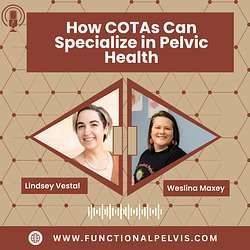
It's the question I've asked Weslina Maxey more times than I can count over the years we've known each other, and the one I hear constantly from the community: can COTAs be pelvic floor specialists?
"COTAs belong in this field just as much as OTRs. COTAs can specialize in the pelvic floor."
— Weslina Maxey
Weslina became a COTA in 2018 and an OTR in 2024. In between, in 2022, she opened her own pelvic health business — and ran it for more than a year and a half as a COTA, forming the LLC and seeing clients on her COTA license.
So this isn't theoretical. In this conversation she walks through how she did it, how the supervision actually worked, and all the things she wishes she'd known at the start.
Can COTAs do pelvic floor therapy?
Yes. COTAs can specialize in pelvic health the same way they can specialize in stroke rehab or hand therapy.
Can a COTA open a pelvic health business?
Yes. Weslina formed her LLC and saw clients as a COTA, contracting an OTR to sign off on her documentation and assessment outcomes.
Does the supervising OTR need a pelvic health background?
No. Weslina's did not. What matters is that they know you're competent in what you're doing and educating clients about.
Can COTAs do internal work?
Yes, with the competency behind it — the training that shows you've learned how, and that you know what you're doing.
Do you have to start a business to work in pelvic health?
No. You can bring pelvic health education into the setting you're already in: acute care, inpatient rehab, skilled nursing, home health.
Check your state
Supervision requirements and scope of practice for OTAs are set by state licensure boards and vary — sometimes significantly — from state to state. What Weslina describes is what worked in her state and her setting. Before you make plans around any of it, check your own state practice act and your licensure board's guidance on supervision, documentation and billing.
In this episode:
- How Weslina built a pelvic health business on her COTA license
- How remote supervision actually worked week to week
- Why competency, not specialty, is what your supervising OTR needs to verify
- The three assumptions about pelvic health work that stop people before they start
- A route into pelvic health education that doesn't require a license at all
"Yes, you can open your business and be the head of it as a COTA"
Lindsey: Weslina, thank you so much for being here to talk about something incredibly important — whether or not COTAs can be pelvic floor specialists. Thank you for coming on and settling this once and for all.
Weslina: You're so welcome. And yes, COTAs can be pelvic floor specialists.
Lindsey: Say that loud and clear one more time, for everybody with doubts or questions.
Weslina: Yes. COTAs belong in this field just as much as OTRs. COTAs can specialize in the pelvic floor.
Lindsey: Talk us through your journey. How did you start, and where are you now?
Weslina: In 2018 I became a COTA. In 2024 I became an OTR. In between, I bridged over and opened my business in 2022. So I was a COTA running my business as a pelvic floor specialist for about a year and a half before I became an OTR. I was able to open the business, create the LLC, and see clients on my COTA license.
Lindsey: You just said two things that are probably the most common questions we get. One, you worked in pelvic floor therapy as a COTA. And two, you started a business doing it.
Weslina: Yes and yes. I'm glad you're asking, because you can open your own business and be the head person of that business as a COTA. Before I bridged to OTR, I hired an OT as a 1099 contractor, so they could sign off on my documentation and my assessment outcomes.
How the supervision actually worked
Lindsey: That's probably why many people aren't sure they can do this. They're thinking, do I have to get signed off? What if there's no OTR at my facility? It sounds like you did all of that virtually.
Weslina: Yes. We'd meet for business matters and for clients, bi-weekly or even weekly at first, just to make sure we had everything covered. Then as we got to know each other and she saw how competent I was in the pelvic floor world, we were able to space those out a little. We used Zoom.
Lindsey: Does she have a background in pelvic health? Is that a requirement?
Weslina: She does not. That is not a requirement. It's the same idea as a COTA specializing in stroke rehab or hand therapy. You can still do that work as long as you show you're competent, and your OTR knows: hey, I trust this person, they have competency in this field.
Are you competent? Do you know what you're doing? Do you know what you're educating on? If you do, that OT should have no problem signing off on your documentation and your work with clients.
Lindsey: This is so liberating for so many people listening. There are more pelvic floor clients out there than we can serve, and I believe the more OT practitioners available to help them, the better the world is. Especially that the OTR doesn't have to be in pelvic floor therapy — that opens up so much.
Do you have advice on how to find an OTR to sign off on notes?
Weslina: It starts with conversation. Just saying, hey, I'm interested in this. Someone next to you might know a person who'd be interested in learning more about pelvic floor themselves. Because once they sign off on you, they probably do want to know more about it. Just like any OT, we want to keep learning.
You can educate them: here's what the improvements look like, here are the assessments.
And another thing I hear a lot is, can you do internal work? Yes, you can as a COTA. You just have to have the competency — the course behind you to show you learned how to do this, that you know what you're doing, and that you know what you're educating your client about.
Learn with me for free
Start where every pelvic health OT starts, with a free AOTA-approved CEU class. Take either one, or both.
New to pelvic health?
The OT Practitioner's Role in Pelvic Health
Where pelvic health sits in OT scope of practice, plus simple interventions you can use with clients tomorrow.
Free · 1 hour · 0.1 AOTA CEU
Sign up for freeWondering where it fits in your setting?
The OT's Guide to Pelvic Health Practice Settings
Nine settings where OTs are already doing this work, from hospitals and SNFs to living rooms and L&D units. No private practice required.
Free · 1 hour · 0.1 AOTA CEU
Sign up for freeWhere to start with training
Lindsey: On the competency piece — you trained through me, you took OT Pioneers and also Level 1. Now that you've done both, what would you recommend to someone just getting started?
Weslina: If you're dipping your toes in, OT Pioneers is a perfect course for that. It's exactly what I took at the very beginning. Before I'd even finished the course, I signed up for my LLC.
It's a great way to make sure you're totally into this before going into something like Level 1, which is a big commitment and a lot more information. So OT Pioneers is a dip-your-foot-in, get-the-information-you-need course. Make sure it's what you want to do, and then go further afterward.
Lindsey: One quick note, because it matters to me. The Level 1 program includes a lab and a second course covering the colorectal area, and I give bridge tuition credit to students — so if you've taken OT Pioneers and then jump into Level 1, you get that financial credit toward the Level 1 program.
I want folks to see the trajectory: do I know I want to do pelvic floor therapy, and if I do, how far do I want to take it, in a financially responsible way?
You don't have to start a business
Lindsey: You did this in such a creative way — you're a very driven person who goes for what you want, and it's one of the things I admire about you. But I bet some people listening are wondering whether they have to start their own business to work in pelvic health. What would you say?
Weslina: No, you do not. I love owning my own business, but if I could go back, I might have started a little here and there in the settings I was already working in as a COTA.
I'm glad I did it and I don't regret it at all. I just didn't know that when I first started looking into pelvic floor therapy. I thought, okay, I'll open my own business, it's fine. It worked out.
But I still do PRN at a hospital in acute care, about once a month, and I bring my pelvic health education there too. We have so many patients with incontinence, with constipation, with prostate issues, back pain, hip pain, hip surgeries, abdominal surgeries, back surgeries — all the things.
Where you can bring pelvic health education:
- Acute care
- Inpatient rehab
- Skilled nursing facilities
- Home health
- Community workshops
Weslina: And again, the OT signing off on your documentation doesn't have to be specialized in pelvic floor. They just need to know you're competent in what you're educating your client about.
What that looks like in practice
Weslina: Say you're seeing someone after a hip surgery. You're educating them on how it affects the pelvic floor — how the hip connects to the pelvic floor, so we can prevent incontinence from developing, because that happens a lot after hip surgery. We lose the coordination of those muscles, or they weaken.
So we work on hip strength, even with the restriction in place. Then as they move into inpatient rehab, how do we bring it into that setting? Then home health, skilled nursing, whatever it is — how do we continue that trajectory so we prevent pelvic health symptoms from developing? And if symptoms are already there, how do we address them?
So that nobody ends up saying, I had a hip surgery when I was 50 and I've had incontinence ever since.
Lindsey: I love that. Everyone with a pelvis could benefit from pelvic floor therapy across their lifespan. And in under a minute you walked us through how someone curious about this can step back, look at their current setting, and see that there's a place for them.
It doesn't mean doing it full time. And it definitely doesn't mean doing internal work.
In fact, my course is the only one that teaches a menu of options starting with the person fully clothed. Yes, one of those options involves clothes off and an internal exam. But one of the things I'm most passionate about is that we don't have to do the internal exam. I pause and ask us to consider whether it's actually appropriate. We've been sold that it's the gold standard, and it may not always be what our client needs.
So for anyone listening: take advantage of the setting you're in. Use what you learned in OT Pioneers right there. You don't have to be in outpatient. You don't have to start your own business. You don't have to do internal exams. And you can still provide so much quality of life to your clients.
"Why aren't we talking about the pelvic floor?"
Weslina: Exactly. At the acute care hospital I've created a handout, and I'll be doing an in-service on it soon — on how whoever's seeing the patient can bring in pelvic floor education. How do we do that during transfers? When they're sitting on the bedside commode? Positioning, breath. Plus an educational handout for the patient.
How do we start bringing the pelvic floor into everyday life, and teach our patients to do the same? Because like you said, everybody with a pelvis can benefit. So why aren't we talking about the pelvic floor muscles when we're working on every other muscle and movement during their stay?
If someone has a stroke and their left side is affected, then the left side of their pelvic floor is affected too. So why aren't we telling them, hey, you might have a lack of sensation there, you might have a pins-and-needles feeling in that area? It's the same idea as the fingertips or the feet. But we don't talk about it, because it's so taboo.
We'll bring them to the bathroom and help them wipe. But we won't talk about the muscles we're doing that with. It makes no sense. Like you always say — toileting is an ADL. Sex, pee, poop, all of it. It's something we need to be talking about, in any setting, every setting, and with every discipline.
One more route in
Lindsey: Is there anything else you'd want anyone listening to know or consider?
Weslina: You can also run community workshops to get pelvic health education out there — so people know what pelvic floor therapy is, and how to start taking care of it. That way they can avoid a hospital trip because they fell due to urge incontinence. And you can do that without a business.
The other part is that if you do open a business, it doesn't necessarily have to be under your OT license. Say you want to be more of a pelvic health educator, or a pelvic health wellness specialist. That's a route you can take without having an OTR above you.
You wouldn't be able to do manual work or internal work, because you're not operating under your OT license. You'd be under that wellness background — with an OT background behind you, obviously. But if you want to go the other route with your OT license, then you'd need the OTR and all of that.
Lindsey: There are just so many ways to do this. The call to action, after listening to you, is: if you think pelvic floor therapy is for you, if you think you can add something to your current practice setting and to your clients' quality of life, go for it. It's the most fulfilling specialty there can be, and we need more of us out there doing it.
Weslina: Right. It's an awesome specialty. And like you said, you don't go back — because it's such an important muscle, and it connects and affects everything in the body.
