
What Pelvic Health Hiring Managers Look For in an OT
OTs in Pelvic Health Podcast · 33 min listen
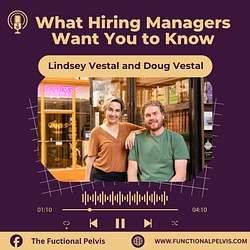
If you're an OT applying for pelvic health roles — and you keep hitting job descriptions written for PTs, or experience requirements you don't yet meet — this is the view from the other side of the table.
I'm Lindsey Vestal, and I asked my husband Doug to join me for this one. He spent years as a senior manager in the corporate world, managed thirty employees across New York, London and Hong Kong, wrote the job descriptions, and has interviewed hundreds of candidates. He's seen what makes someone stand out, and it's rarely what applicants think it is.
"I can't tell you the number of times I've interviewed a candidate who on paper checks all the boxes. Plenty of people check all the boxes. That is not the only thing hiring managers are looking for."
— Doug Vestal
Part of my responsibility in teaching pelvic health is being curious about what it actually takes to get my graduates employed. It isn't enough to have the skills. You have to make a living with them.
In this episode:
- What hiring managers rank above qualifications, and why
- Why a job description saying "pelvic floor physical therapist" isn't the red flag you think
- What to do when you have the training but no paid experience
- The follow-up line almost nobody uses, and why it works
- How I got my first pelvic health job after HR put my resume in the decline pile
- What to say when you don't know the answer in an interview
The thing that matters more than qualifications
Lindsey: What are some of the things people could get right?
Doug: Most people would say qualifications first. As a hiring manager, I'm not going to say that.
I'm going to say it's how you show up. How you conduct yourself. How you bring excellence to the way you describe your work, the way you conduct yourself in the interview, and how you follow up afterward.
Because I can't tell you the number of times I've interviewed a candidate who on paper checks all the boxes. And there are a lot of people who check all the boxes.
Hiring managers take a step back and look at cultural fit. Is this someone you want to spend eight or ten hours a day with? You spend more time with your coworkers than with your family.
That was always a big theme for me when I was hiring. Is this someone I'd want to break bread with?
Lindsey: From my own experience, both as an applicant and hiring people myself, I agree completely.
When I was getting started I was so worried about not having the right qualifications. This was over a decade ago, when there were even fewer options than now.
But I think the door opened because of my enthusiasm. My energy. You could tell I wasn't going to leave until I got that job.
And I thought about everything you're describing — what I'd do beforehand, what I'd do afterward. Even simple things like writing a handwritten thank-you note, which sounds old-fashioned. It's a lost art. It's simple, and it makes you stand out vividly.
Doug: Interviewing is a bit like professional dating.
Are you going to want a second date with someone who shows up late, isn't dressed for the occasion, doesn't have a good attitude? If they're not showing enthusiasm for the conversation, are you going to want to see them again?
At the end of the day we're just people. We pick up on the vibe of whoever is sitting across the table.
We think it's about hard skills, but so many people have the hard skills. It's really about the soft skills.
The follow-up almost nobody does
Doug: When you leave the interview, are you telling them you're excited about the position? That you can see this being a future home for you?
What to say
I'd love it if it's a yes. I understand you need to talk to some people internally — would it be okay if I followed up with you five days from now?
Doug: That shows you're a self-starter. It shows this matters to you. And it doesn't put pressure on them. You're just saying: I think this is a good fit, and I want to make sure you agree.
Lindsey: It also shows you're already thinking about the next step. Asking permission for it demonstrates that you aren't going to take no for an answer.
And when I say that, what I mean is: this person is driven and focused and won't stop until they get a job in this field. That's exactly how I felt when I got my first job.
Doug: You're doing everything under your power. You can't control other people, but you can control how you act.
The two objections we hear most
Objection one
"The job description says pelvic floor physical therapist."
Here's a sneaky thing a lot of people don't realize. When someone resigns, you dust off the old job description from three or four years ago. HR sends it over, you're stressed, you're busy, you glance at it and hit approve. And it goes out on Indeed and everywhere else.
So you may simply be looking at a description that hasn't been updated in years. Don't take it as a red flag not to apply. Take it as a green light — once they see your qualifications, they'll probably make an exception.
The other thing is that hiring managers often write the description looking for a unicorn. Five to seven years' experience. This course. That other course. And that person may not actually exist.
When I was updating job descriptions on Wall Street, I'd put everything in and send it to one of my regional team leaders. And they'd email back: Doug, I don't even have those qualifications.
It's a wish list. If they find someone with all of it, fantastic. But don't be discouraged if you don't have every bullet point. I've hired many people — some of my best hires — who didn't meet every line.
Objection two
"I don't have experience yet."
This is where you can really shine, because every hiring manager loves a self-starter. If you don't have experience, what you do have is your time and your energy. Deploy it.
What does that look like? You have the skills. Practice them on your spouse, your partner, your sister, a friend, someone in your community. Then create a small portfolio of case studies from those evaluations.
I saw Janet, she was six weeks postpartum. Then I saw Sam.
Write it up and show it to the hiring manager: I know I don't have that experience, but here's the coursework I've done, and here's how I'm already using it to provide pro bono services within my network.
Hiring managers pick up on that. Because employees who aren't self-starters are hard to manage, hard to move on from, and they bring the rest of the team down.
Learn with me for free
Start where every pelvic health OT starts, with a free AOTA-approved CEU class. Take either one, or both.
New to pelvic health?
The OT Practitioner's Role in Pelvic Health
Where pelvic health sits in OT scope of practice, plus simple interventions you can use with clients tomorrow.
Free · 1 hour · 0.1 AOTA CEU
Sign up for freeWondering where it fits in your setting?
The OT's Guide to Pelvic Health Practice Settings
Nine settings where OTs are already doing this work, from hospitals and SNFs to living rooms and L&D units. No private practice required.
Free · 1 hour · 0.1 AOTA CEU
Sign up for freeHow I got my first pelvic health job
A story
My first job was advertised for a pelvic floor physical therapist, and HR kept overlooking my resume.
I called. Several times — five or six — before the HR rep finally told me my resume had gone into the decline pile because I didn't meet the base requirements.
I asked which requirements. She said: you're not a physical therapist. You're an occupational therapist.
I tried to explain why I was still a candidate and still qualified. For her it was black and white. She didn't have the authority to override it, however good my answer was.
So I decided to show up at the clinic.
I went at lunchtime, deliberately, because I knew it would be slower. There was still a line, and the front desk knew why I was there — but every time a client came up, I politely stepped aside. I was already demonstrating respect. I don't want to be in the way. I'm not here to cause problems or be a thorn in your side.
Eventually the receptionist went back to the hiring manager, who was on her lunch break. She said she had a few minutes, and to send me through.
By the way: that job had been posted for over a year. They'd been trying to fill it for over a year. My guess is that's part of why she saw me.
And then pure luck. It turned out we'd worked at the same company — a software firm where I'd been a technical writer, because my first degree is in English, before I became an OT. I knew because she had the name badge out. She was proud of it; it was a prestigious company locally.
So we already had something to talk about, and we were laughing.
Then I told her about all the courses I'd put myself through, and about practicing my skills pro bono — which I'd already started doing. Like I said, I wasn't going to take no for an answer. I knew I was meant to be a pelvic floor therapist. The only question was who would open the door.
She took me back to the head therapist, a physical therapist, and we agreed I'd come back on Monday to shadow.
I got there thirty minutes early. My whole job that day was to follow the therapist around. I volunteered to wipe down tables and turn rooms over — they already had technicians for that. But I thought: you're giving me a gift. What can I do to go above and beyond and show I appreciate it?
At the end of the day, they offered me a full-time job.
Doug: And imagine if you'd shown up differently that day.
What if you weren't asking questions? What if you looked like you didn't want to be there? What if you weren't effusive in thanking them, or proactive in seeing how you could help?
These are all things that are completely free. They don't cost money or experience. It's how you show up.
They knew you had the background and the training. What they were working out was whether you'd be a cultural match. And the answer was: we need to bring Lindsey on board, she has great energy and she's proactive.
The volunteer we ended up hiring
A story
At the fourth annual OTs in Pelvic Health Summit, we had over a hundred attendees and an army of volunteers. The summit genuinely couldn't happen without them — signage, food, restocking. With a hundred people in a room there's a lot of opportunity for things to go wrong, and while I'm hosting and attending talks, I can't fix any of it.
One volunteer spent a little time talking with our kids, who were there.
Afterward she went out of her way to buy them a thoughtful gift based on what they'd mentioned enjoying, mailed it to our house, and wrote a lovely note reflecting on her time volunteering. It was a thank-you note. This wasn't a job interview. She happened to be a past Level 1 graduate.
What struck me was that she'd been listening. I asked our kids about it — it had been a conversation of less than two minutes. She heard it, picked up on it, and acted.
It was remarkable. And it became a teaching moment for our own children about how you make an impression, and how you let someone know something mattered to you.
Days later, Doug and I were in the car and a thought popped into my head: I want to hire her.
Not because of anything she asked for. She wasn't looking for a job. But because of what she'd demonstrated during the event and afterward. I want to be around self-starters. I want to be around people who show up with integrity and excellence.
We did end up hiring her, on a project basis.
Doug: This is something hiring managers look for even when you're simply networking, or interacting with people in the real world. We wouldn't have known she was a great fit if she hadn't shown up that way.
Doug's weekend
A story
Doug: My big break was moving from risk management to the trading floor. That's where all the action is, and it's enormously competitive — for every one spot you might have three to five thousand applicants. The best route is networking internally.
A job came open. The sales team was in a bit of a pickle, because they'd sold something to a client and didn't know how to risk manage it on the desk. I had a background in that product from my PhD, but I'd never done anything with it in the real world. It was all theoretical — my dissertation.
That at least got me the interview. The man interviewing me was called Duncan, and his whole purpose was to understand how I'd risk manage it day to day. I did my best, but I'd literally never done it. I'd written papers about it. Fingers to the keyboard, actually doing it — no.
I think I did okay. Probably not well enough to get the job.
That was a Friday. I came home, we talked about it. And then all day Saturday and Sunday I went into the office and built the thing that would let them risk manage it.
I was still in the office around 11pm on Sunday. Duncan was based in London, so it was 6am Monday his time when I sent the email. If you know people on Wall Street, they're always on the BlackBerry. He wrote back straight away.
I'd developed the whole program, the whole structure. I spent the entire weekend on it. I didn't have the job. I didn't even think they were going to give it to me.
That Monday they called me in and gave me the job.
The reason was that I'd solved a really big problem for them. They were looking for the self-starter who maybe didn't have everything figured out, but could run it down and work it out.
Lindsey: Would you have done it if you hadn't known it would get you the job?
Because a lot of people say that's too much work, or I'll only do that if I know it'll pay off. What I'm getting at is that you've never been that person.
Doug: I've always had the perspective that you either win or you learn.
And I still do it today. What's really important to me — and we talk to our kids about this — is that opportunities don't always come back around. So you have to maximize them. You can't sit on it and think next time I'll show up differently. Let's show up differently today.
You don't know whether there'll be another job after that interaction with that hiring manager. These things don't come up often.
So I approach it as: if this were the last thing I did, what does showing up look like?
I'd have done it even without certainty. And at the time there was zero certainty it would lead to anything. They didn't ask me to do it. They didn't know I was working on it.
"I'm going to find out for you"
Lindsey: I tell my Level 1 and Level 2 students that when a client asks about something you don't know, say I'm going to find out for you — and then actually follow up with the answer.
That solidifies the relationship, because now when you do speak with authority, they know it's authentic. It also shows humility, which is a big part of building therapeutic rapport.
And the same idea applies in an interview.
Don't be afraid when a hiring manager asks something you don't know. That's an opportunity. You can do what Doug did — follow up afterward.
What to say
I know you asked me about interstitial cystitis, and I don't think I gave you a satisfactory answer, because I don't have a lot of experience with it yet. So I've mocked up a case study on some possible interventions I'd provide.
Lindsey: Going above and beyond like that speaks volumes about who you are. You're a lifelong learner, and you're demonstrating that you don't stop when you don't know the answer.
That would be a very attractive response from someone who had, quite bluntly, said in the middle of an interview: I'm sorry, I don't have experience with that.
So I hope that reframes some of the imposter syndrome around not knowing how to answer a question. It's actually an opportunity to make yourself the candidate who gets the offer.
Doug: It also demonstrates that they don't give up.
A lot of our interviews were very technical — essentially math problems. We wanted to know you could think on your feet and understood how markets worked. And they were designed for you not to get them right. We wanted to see how someone performed under stress, when they were nervous, because you'd be talking to clients about complicated products.
There was a distinct difference between the candidate who said I'm not sure, but give me a little time and I can figure it out — and then sent an email afterward having solved it — and the candidate who said I don't know, and whom we never heard from again.
The first person demonstrated three things. They don't give up. They're a person of their word. And they genuinely want this.
The three pillars
Doug: It comes back to three things.
1
Qualifications
Which you have. And if you don't have the experience, create the experience yourself — because often you'll have to do it for yourself before someone else will give you the chance.
2
How you show up
Show up with excellence. Treat them the way you want to be treated. Show your enthusiasm, show you're a self-starter, show you can persevere.
3
The follow-up
Make sure you follow up afterward, because it matters enormously and not many candidates do it.
Doug: Here's the industry secret: not a lot of candidates show up the way hiring managers would want them to.
So if you're the person who shows up differently, that's low-hanging fruit, and it makes you extremely competitive. You might not think it makes much difference. It fundamentally does.
Just showing up with that excellence mindset will take you much further than you're probably giving yourself credit for right now.
