
How to Pitch a Pelvic Health Role as an OT When the Job Doesn't Exist
OTs in Pelvic Health Podcast · 38 min listen
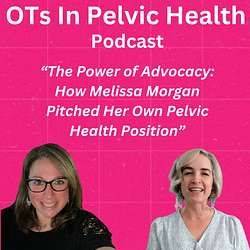
If you're an OT who wants to work in pelvic health but can't find a job posting for it — this is a conversation about creating the role instead of waiting for one.
Melissa Morgan is a licensed OT in New Jersey who came to the profession as a second career, after athletic training. She's a student in my Level 1 Functional Pelvic Health Practitioner program, and she now works in pelvic health, sexual wellness and perimenopause coaching at a practice that had no pelvic health position before she pitched one.
"Basically I was a salesperson. I went in and sold myself, and I sold pelvic health — and how important it is to have in your setting."
— Melissa Morgan
I'm Lindsey Vestal, an OT in pelvic health. What follows is exactly how Melissa did it: how she found the practice, what she brought to the meeting, and her advice for anyone who isn't as extroverted as she is.
In this episode:
- Where she met the practice that ended up hiring her
- The one-page document she made, and what she called it
- What she said in the meeting, and the line from the owner that told her it was a fit
- How to do this if you're introverted and the thought of a pitch makes you ill
- The reframe she uses on imposter syndrome
- The distinction she wishes every woman had been told decades ago
How she found pelvic health
Lindsey: What drew you to pelvic health? Did you always know this was the path?
Melissa: Actually no, because this is my second career. My first was athletic training — I was always an athlete, so I thought I'd stay there with the athletes. I didn't know about OT back then. If I had, I'd have fallen in love right away.
I went into OT and stuck with pediatrics. And then what started me on this is a funny story.
If anyone's familiar with Pure Romance — it used to be a direct sales company — a friend of mine wanted to host a party and we couldn't find a good rep. I'd been in direct sales before, so I thought, let's do it.
And as I started doing these parties, I noticed that women don't know enough about their bodies. They don't know that down there is called a vulva, not a vagina. Some don't know what the clitoris is, or how big it actually is.
That's what started me. I began listening to podcasts, found yours, and it took me where I needed to go.
I did take a little step off and went to Herman & Wallace first. And then while I was in Herman & Wallace, I learned all about Lindsey and OT Pioneers, and it went right in that direction.
Lindsey: I love that you came to it through education. You've got the personality for it. And it happened to lead you down a path you're deeply passionate about.
On taking Herman & Wallace first
Melissa: Whenever somebody asks me what they should do — or says I took Herman & Wallace and I'm ready to go — I always stop them in their tracks.
I took Herman & Wallace before I knew about you. And it's a great course, but it's a crash course, I feel. And no offense to the PTs taking it, go for it. You might already be in a setting where you have more information than I did. That's great. I didn't get that education in OT school.
So when I left there on that Sunday evening and they said go for it — I was like, no, I'm not. I don't feel comfortable.
You did coursework beforehand, and then when you went there you did more coursework, and you had the labs in between. And I don't feel it gave OT — and we're special, because we have that biopsychosocial aspect of what we do. We look at the person as a whole. You don't get that in Herman & Wallace.
So I highly, highly recommend going your route with OT Pioneers. Not only for what I've learned taking the courses and from the different speakers you've had — those live calls we have, going one-on-one, are outstanding. I think I've learned more in those settings than I did before.
And I love that in some of the calls you have our peers educate us on certain conditions of the pelvic floor. It's nice to hear from other people talking about it and understanding it.
Melissa: So as an OT, I know I was not prepared with Herman & Wallace. I honestly was kind of turned off. I was even thinking about going to another of their courses, before I looked at you more in depth and looked at OT Pioneers — and that made up my decision right away.
Not that I didn't meet some amazing people in it, and not that I didn't learn a lot. I have one PT who follows me to this day and is always cheering me on. Go Melissa. Alyssa's a sweetheart. She's always helping me out, always in my corner, as a PT. She was an assistant instructor there.
But what you provide for OTs — I feel like I'm way more prepared than I could have imagined. And we have that support system. I feel like I can't call on anyone in Herman & Wallace right now, where I can always go into our community, or to you. You're always there for me.
I highly recommend OTs go this way. You get so much more depth, and it's more of what our field is. Our ADLs. We have to pay attention to that, and that's our scope of practice.
Melissa: I'm 45, I had my kids late, and I think most of us have had some form of pelvic health dysfunction at some point. My births were natural but I did tear. I have incontinence myself. I have back problems that contribute to it.
So I thought: I need to help people. I need to help women.
Imposter syndrome, and the reframe
Lindsey: Many OTs struggle with imposter syndrome entering a new specialty. Did you?
Melissa: Everyone will. This is a little niche of OT, and in my school they taught us nothing about pelvic health. And as OTs we're not trained as heavily in the muscles — I feel like physical therapy emphasizes that more.
Even now, while I'm advertising myself, I watch the pelvic health PTs in my area who are on Instagram and think: can I really do what they do? Do I know what I'm doing?
And then there was something from one of your podcasts that really stuck.
"I know more than the person walking in right now, and I can help them, because I have that."
— Melissa Morgan
Melissa: So I keep telling myself: I know this information. I'm passionate about this. I have the skills. I can do this.
I had imposter syndrome when I started as an OT in my second career too, and looking back — everyone learns by doing, by being in the situation. I think if I look back at this in five or ten years I'll wonder why I felt that way.
Lindsey: And if we don't get started, we never get the chance to practice and grow. Besides imposter syndrome, the other thing we share as OTs is wanting to be lifelong learners. You can't challenge yourself into becoming the expert you want to be if you never begin.
My husband Doug always says you just have to read one chapter ahead. Stay one step ahead and you've got this.
Learn with me for free
Start where every pelvic health OT starts, with a free AOTA-approved CEU class. Take either one, or both.
New to pelvic health?
The OT Practitioner's Role in Pelvic Health
Where pelvic health sits in OT scope of practice, plus simple interventions you can use with clients tomorrow.
Free · 1 hour · 0.1 AOTA CEU
Sign up for freeWondering where it fits in your setting?
The OT's Guide to Pelvic Health Practice Settings
Nine settings where OTs are already doing this work, from hospitals and SNFs to living rooms and L&D units. No private practice required.
Free · 1 hour · 0.1 AOTA CEU
Sign up for freeHow she pitched the role
Lindsey: You created a pelvic health position where one didn't exist. How did you advocate for yourself and pitch it?
Melissa: This was tough for me.
After OT Pioneers I thought, okay, I'm ready — but what setting do I want? Going into private practice alone, I wouldn't have the support I wanted. I spoke with a friend who runs a mental health clinic and wants to move into women's health, but the timing didn't line up. She didn't have the room for me yet.
She went where her people already were
A local moms' group held a big luau that summer, with vendors. I was there talking about Pure Romance, and I mentioned that I was going to start practicing as a pelvic floor therapist.
Someone told her to come and talk to them
The Spine and Health Center of New Jersey came over, and they said: you need to come talk to us. When the event died down, I went over to their booth and met Carrie, a physical therapist who has been with the clinic for years.
She told me they didn't have an OT, and the one they were hiring wasn't pelvic floor — she was lymphedema and orthopedics.
She researched the practice before approaching them
It's a chiropractic, physical therapy and functional medicine facility. They didn't talk much about OT. But they had the same sense I do — they look outside the box instead of staying strictly inside it.
She made a one-page document and gave it a name
I took what I knew and put it into a flyer. It wasn't my resume. It was my pelvic floor, take me on resume.
I made it in Canva, nice and neat, with all the reasons you should bring pelvic floor into your facility.
She used a warm introduction
I contacted the owner, who happened to be a good friend of a friend of mine. I said: give her a heads up that I'm calling, and that she needs to talk to me. It's important.
She went in and sold pelvic health, not just herself
I met Kelly, a chiropractor, and Carrie. I explained this is an up-and-coming field, and that as an OT I take the biopsychosocial approach — I look at the body as a whole. We don't just focus on the pelvic pain, or just the incontinence. There may be other things going on in someone's environment.
Melissa: And their energy matched mine.
I'd said I'm very out there, I'm loud, I love to talk. My husband gets annoyed with me sometimes — they call me the mayor of the town, because I walk around talking to everyone.
And Dr. Kelly said: Melissa, your energy is awesome. That lioness you have in you — don't ever tame it.
That's when it clicked. These are my people.
I was so nervous going in, and so pumped walking out. As I was leaving they said: let's get this done, when are you ready to go?
Melissa: Basically I was a salesperson. I went in and sold myself, and I sold pelvic health — how important it is to have in your setting. Because women don't have enough options. Even now when I say I do pelvic floor, people ask what is that? And I think: you're a woman, you should know this.
I'm sitting in my therapy room right now with all my pelvic floor models and my signs up, and I'm ready to go.
Lindsey: You didn't only advocate for your future clients with that proposal. You advocated for our profession, for yourself, and for your family. It took courage, and it worked.
And I believe if it hadn't worked, you'd have found the next place, and the next. I don't think you'd have given up.
You also got lucky that the energy matched — that they loved you as much as you loved them. That's rare and beautiful.
But notice what you did first. You found a place that was already out of the box, already creative and solution-oriented. You didn't go to a hospital-based system. You didn't go corporate. That's a bit like finding your ideal client.
If you're not an extrovert
Lindsey: Not everybody reading this is as extroverted as you are. But I know they're as passionate. What would you say to someone who wants to do something similar, in a way that's authentic to them?
Melissa: Find the way you communicate best.
If that isn't you
- If reaching out by email first feels better, do that
- If you'd rather have a one-on-one conversation on the side, do that
- If you want to practice interviewing with someone first, do that
- If a program is the better route, develop one where you already are — a hospital, a skilled nursing facility. That's where women need it most, walking around with UTIs and nobody helping them
Melissa: I'm reading Let Them by Mel Robbins at the moment, and it's an awesome message. I had to learn this at an older age, because I was the typical child and teenager who let other people's opinions matter far too much.
If you have the passion and you want something, you have to go out and get it. Don't let anyone stop you.
There are PTs in my area who might take a different approach than me. Am I going to be able to do what they do? I just remember that I might have a different approach — and that's about finding the clients who suit you.
So don't hesitate. If you're nervous about selling yourself, or about going out to clinics, or about developing a program — keep going. If you strike out, keep going.
Lindsey: I like how you anchored that around communication, and finding the form of it that's authentic to you. It doesn't have to mean being on TikTok pointing at invisible word bubbles.
Where to start, if you're earlier than that
Melissa: There are so many OTs coming up in pelvic floor now.
Do your research. I reached out to OTs through the Facebook group and they were all amazing — if you want to call me, go ahead. We're an incredible community.
And honestly, what makes a great OT is the person you are and how you treat others.
I get such a high after the live calls in your courses. The people at work ask what I've taken. What caffeine did you have? I say: I'm high on life. This is my passion.
You can see in those calls that some people are afraid to speak up, but we're in the chat box cheering each other on. What a great point. You've got this.
I'd welcome any student or any OT who's interested. If this is their passion, they need to follow it.
What makes it worth it
Lindsey: What's the single most rewarding aspect of working in pelvic health for you?
Melissa: Hearing from the women I educate.
One woman wrote on a post of mine: I wish somebody had told me sooner. For two years I was forced to deal with this, and doctors told me it was normal.
And there was a discussion in the community about leaking — that it's common, but it's not normal. If someone had told women that years ago. It's common, but it's not normal. I can help you, and it could be an easy fix. I don't have to see you for months and months.
Women don't realize that.
Melissa: My own mother, after I learned more about PCOS and really looked at what she'd described — cysts on her ovaries, excessive hair growth, terrible periods, trouble getting pregnant.
I said: Mom, you had PCOS.
She said what? I explained it all and she said, oh my gosh.
She had a hysterectomy at fifty, and she's in her seventies now, and nobody ever educated her about any of it.
So hearing women get better, feel better, feel more normal — that's what I love.
The mantra that shaped her
Lindsey: Is there a mantra, a book or a piece of advice that's shaped your career?
Melissa: My dad taught me this at a very young age. He's very old school — you go to work unless you're on your deathbed.
"Melissa, if you want something, you have to go out and get it. It's not going to fall in your lap."
— Melissa's father
Melissa: That's always in my head. I feel like I've gotten where I am because of him, and how he brought me up.
I also listen to a lot while I'm driving. Dr. Kelly Casperson is a great resource — a urologist who has really focused on helping women rather than leaving them to the side.
And one book that stays with me is All in Her Head. It's about how women have been treated throughout medical history, and still are. It goes back into the days of slavery, and the surgeries performed on enslaved women without anesthesia in the course of developing gynecological techniques.
And I think: this is not okay. Women were always tossed aside. It's not okay anymore.
We're finally starting to have a voice. We don't need to drink wine to feel better about ourselves. We don't need to be in pain during sex. We don't have to pee our pants every time we laugh.
This has to stop.
