
How to Fill a Pelvic Health Private Practice as an OT
OTs in Pelvic Health Podcast · 28 min listen
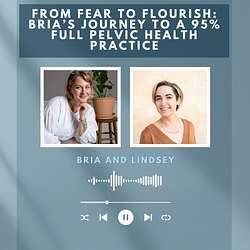
If you're an OT thinking about opening your own pelvic health practice — and quietly wondering whether anyone would actually book — this conversation is the one I'd want you to read.
Bria left a cash-based practice in May, opened her own doors three and a half weeks later, and by month five her caseload was 95% full with a waitlist. She's 29. She did it without poaching a single client from her previous employer.
"Stop begging for a seat at the table that's already yours. It's had your name. Sit down, girl. Sit your butt down, unclench your glutes, and ask for seconds — because you're supposed to be there."
— Bria
I'm Lindsey Vestal, and my husband Doug joined me for this one. What follows is how Bria actually filled that schedule: the exit, the referral sources that worked and the one that didn't, and the mindset shift she credits more than any marketing tactic.
In this episode:
- The three-and-a-half-week gap between leaving and opening, and why she planned it that way
- How she handled telling her boss, and what she did about clients who wanted to follow her
- The one marketing activity she tried once and abandoned
- Where her referrals actually come from — it isn't OBs
- The reframe she used when the schedule had holes in it
- What she does to plant seeds she won't harvest for a year
How it happened
Doug: Your caseload is about 95% full in your own private practice. Walk us through how that happened.
Bria: I'll give credit where it's due — I came from working at a cash-based practice here where I live, so there was pull from the very beginning. We're at month five or six now, which is bonkers to me. It's flown by in the most stunning, stressful, beautiful way.
I was very professional about it. I followed what my old boss wanted: I didn't give people my business cards. I just said, should you choose to follow me, have at it. It's up to you.
I think it's important to give patients that autonomy. If you want to stay here, there are people who'll take care of you, and they're awesome. But at the end of the day, it's your choice.
May 23
Left her position at a cash-based practice
June 17
Opened her own doors
Month 5
Caseload 95% full
Month 6
First waitlist
Bria: I had a gut intuition that I couldn't wait too long. I needed to be doing a lot behind the scenes so I was ready to have boots on the ground and just go for it. It was a little stressful, but not having much of a gap in care was really helpful.
The other piece is that word of mouth is the best thing there is. And I'm comfortable on social media, which helped get the word out. That felt like mine.
Some people are really uncomfortable on social media. But that's where you get to be yourself and have the autonomy to play. The people who resonate are meant to stay. The people who don't will move on and find someone else.
The mindset piece she credits most
Bria: I'd sit at the kitchen table with my printed-out checklist and my coffee, working through Private Pay MBA, Doug's course. My husband started calling it my Doug homework. Are you doing your Doug homework? Yes. Good, good.
And it really helped, because I realized so many of the biases and the negativity and the fear I was feeling were literally in my head. I was making it up. I was my own worst enemy.
So I came up with a mantra. This sounds a little woo, but it worked.
Bria: In the summer there were a couple of holes in the schedule here and there. Last month was the first time I had a waitlist and I thought — what is happening?
Lindsey: Two things stood out to me. The first is your ability to take action quickly, and the foresight to have an exit strategy before you left. You were also very open with your boss. A lot of hesitancy comes from do I have this conversation? Are they going to fire me on the spot? Are they going to see me as a competitor? You brought them in.
The second is that relentlessly positive mindset. Let them think what they want. If I'm not for them, that's okay. And I'm going to open my laptop on Monday and have two new emails.
That combination is powerful.
Learn with me for free
Start where every pelvic health OT starts, with a free AOTA-approved CEU class. Take either one, or both.
New to pelvic health?
The OT Practitioner's Role in Pelvic Health
Where pelvic health sits in OT scope of practice, plus simple interventions you can use with clients tomorrow.
Free · 1 hour · 0.1 AOTA CEU
Sign up for freeWondering where it fits in your setting?
The OT's Guide to Pelvic Health Practice Settings
Nine settings where OTs are already doing this work, from hospitals and SNFs to living rooms and L&D units. No private practice required.
Free · 1 hour · 0.1 AOTA CEU
Sign up for freeHer niche, and where she works from
Bria: Pregnancy and postpartum is great, I love it. But my heart and my joy come from chronic pain and sexual dysfunction. My endo girlies, my endo warriors. And perimenopausal women.
I'm also in a unique space. I rent from a PA who treats only women and works concierge-style, so I get some lovely referrals from her.
The marketing she tried once and never again
Bria: When I was building my nest — figuring out who'd be my referral tree — I thought, okay, I'm going to drop these off at physicians' offices.
I did. Once.
Because I realized this isn't a population of people who refer out unless they've been a patient themselves.
Where her referrals actually come from:
Her own patients in the health and wellness field
Physicians, dentists, nurses, teachers. She sees them routinely, so the first two minutes of a session is often how's everything going with your practice?
Massage therapists
A wonderful source. The ones she networks with either own their practice or are genuinely happy where they are, so they take the time to ask clients how they're feeling and whether things have improved.
One chiropractor in town
Two referral sources she adores, built over lunch when she worked at her previous practice. They clicked on a personal level — both tattoo girlies, both into spooky Halloween.
A physician whose daughter she treated
Now a director rather than a treating clinician. My daughter is very hard to please, and you did fabulously with her. She sends quite a few people.
Word of mouth, above all
You're seeing my friend so-and-so. My friend just had a hysterectomy and I told her about you. I've been hounding her every girls' weekend to come see you.
Bria: It's been humbling and beautiful, because believe it or not I used to be a bit of a loner. Before all this I kept to myself. I'd do the community events my boss shared with me.
Having a space that's my own made me ask: why was I not saying yes to the things I actually wanted to say yes to, and saying no to the things where I'd think — girl, you didn't want to do that, why did you say that?
Planting seeds you won't harvest for a year
Bria: I haven't particularly formed relationships with the OBs. But with patients I'm comfortable with, especially ones I've treated through multiple pregnancies, I plant seeds.
There's one male OB here in town I adore. I met him briefly, he probably doesn't remember me, and that's fine — but all his patients say nothing but good things.
So I'll say: when you go for your six-week appointment, tell Dr. Thompson I said hi.
And if he says oh yeah, great — or wait, who is she? — either way I'm in his brain. Sometimes I have them do the hard work for me, because they're already doing it anyway. They're all troopers about it, whether they carry it through every time or not. Up to the universe.
Doug: You're planting the seeds.
Bria: And I've seen those little nest eggs pay off. I had a patient today I'm seeing exclusively for dry needling, which has been a great strategy — people come in saying I have a tight neck, and then on my intake form I ask whether they have any bowel or bladder stuff, and they say I mean, I poop once a week.
And because it's holistic, because we're not siloed, I can take the time to explain. She said, wait, so you can also help me with my C-section scar that's six years old? Yeah, boo. Let's go.
Bria: And today she told me she was so glad she finally made the appointment. I said, what do you mean, finally? I thought Rebecca — the massage therapist I'm very close with — had just referred her.
She said, oh, Rebecca told me to come to you a year ago.
A year. She said, once you went out on your own, that's when Rebecca said: hey, she's on her own now, you really need to go see her.
So I'd been in her brain for a year. Those relationships might not matter in the moment, but you get what you put out.
I really try to come from a place of love, not for a place of love. There are times when I think, oh, I could connect with this person — and I check myself. Am I genuinely connecting because this is symbiotic? Or because they could help me?
Doug: I always tell people to become the little inner entrepreneur at your work. You can be an entrepreneur where you already are. Develop those relationships, follow up with providers, plant seeds that might not come to fruition for a couple of years.
Because if you're not getting paid in the remuneration you want, get paid in the relationships you're developing.
On doing it scared
Doug: Lindsey complimented your ability to take action, and that's what a lot of people struggle with. We all get in our own heads. A task that should take an hour ends up taking a month. Do you have those tendencies, or are you naturally focused on the next thing that needs doing?
Bria: Honestly, both. I ebb and flow.
A lot of it came from my humble beginnings of having to advocate for OTs in pelvic health from grad school onward. I knew I wanted this well before the pandemic. I met a few mentors who were more you go girl than here's how you do this.
It wasn't until I found Lindsey that I thought, okay, I'm in the right place. That's what prompted me to build my social media — literally because I thought, someone else out there, please.
So that fire under my butt started burning then. And at a time when the risks were lower, I decided I'm just going to do it scared and see what happens.
And it would happen. And it was good. And those tiny bits of confidence kept building.
Lindsey: The do it scared thing is something a lot of Doug's students say, and I've said it a lot myself. The fear never goes away. It just takes on new levels. But those little hits of confidence you get along the way feed the fire.
Bria: Every OT going into pelvic health — you got here for a reason. You have that fire. The question is whether you're actually feeding it. Or whether you're being your own bucket of water, dumping it out yourself, because that's easier.
On procrastination
Bria: I work well under pressure, and I think a lot of OTs do. So with the checklist from Doug's course, I gave myself an imaginary deadline. This is a homework assignment. It's due at 11:59pm. If it's not done, it's late.
Something in my brain goes: no, it can't be late. I have to get this done.
And I remind myself — if you're procrastinating, this is self-sabotage. That's not what we're hustling for.
I know it sounds silly, but a lot of it is internal monologue.
What actually changed
Bria: I told my husband this is the biggest act of self-love I've ever done in my entire life. I could cry talking about it.
I'm a better partner. My husband says I'm so much nicer. I feel better in my body. I have more energy for the things I want to do.
And I realized that being overworked beyond what my body could handle, I was growing resentful of being a therapist at all. Especially in the pelvic sphere.
And I thought: whoa. This is ugly. This is not what I want. I'm young, I have so many years ahead of me. Your interests are allowed to change — but resentment is where we're getting close to burnout.
Doug: So much of the burnout in this profession comes from a lack of choice. Anything you do on a schedule you can't control is going to lead to burnout.
Bria: I never thought I could have the life I want for my future children with what I was making, and with the time I was committed to growing someone else's business. Now I'm at the point where I think — oh, this is going to happen.
Doug: You have a ladder out of the hole.
That's the same story for Lindsey and me. We'd just had our first child, and basically her entire salary was going to pay for daycare and OT loans. And you fast-forward that narrative and think: we're not happy with it now. Why would we stick with it for the next thirty years? It isn't going to improve unless we change it.
What we wanted was to be in the driver's seat. Control the schedule, the finances, the outcomes.
Where to find her
Bria is at Pelvic Flourish, and also at Halsa Wellness and PFT — but Pelvic Flourish is the easier one to find, and it'll lead you to the other.
