
Alyson Stover, AOTA President, on Why Pelvic Health Belongs to OT
OTs in Pelvic Health Podcast · 69 min listen
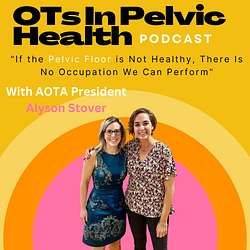
I don't know a single OT in pelvic health who hasn't been asked some version of is this really our scope? Sometimes it's a colleague. Sometimes it's a hiring manager. Often enough, it's the voice in our own head at 2am.
So it meant a great deal to me to sit down with Alyson Stover — OTD, MOT, JD, OTR/L, and president of our national association — and hear her answer it.
What I find so moving about her answer is where it came from. Alyson had no exposure to pelvic health as a student, as a clinician, or as a consumer. She came to it late and from the outside, through a listening session after the Dobbs decision. And she describes the moment it clicked as one of those aha moments you assume you've stopped having twenty years into a career.
"You really can't perform any activity, whether it's an ADL, an IADL, leisure or work. Our pelvic floor is always with us. And if our pelvic floor is not in a state of wellness, there's really no occupation we can participate in to our best ability."
This conversation took place during Alyson Stover's presidency of AOTA, and discusses association priorities set for that fiscal year.
In this episode:
- The five AOTA priorities, and why women's health and pelvic floor made the list
- How a president with no pelvic health background came to see it as foundational
- What trauma care and sensory integration teach us about making a practice area visible
- The three-part playbook: find champions, publish, and refer
- Why giving your expertise away for free teaches people it has no value
- What she'd tell an OT who feels misunderstood or burnt out
The priorities
Lindsey: Can you share your top priorities as president of AOTA?
Alyson: We've been able to move these formally into the vote and see them going forward this fiscal year, and they'll largely be priorities throughout my tenure.
1
Behavioral and mental health
This is where we started as a profession, and it's a place we've never stopped including in our interventions and evaluations. I'm excited to reestablish it as a priority — not just for our profession, but so external stakeholders and consumers begin to recognize that role.
2
Women's health, and specifically pelvic floor
We wanted to make sure the pelvic floor was not forgotten about, because every single person has one. There's nothing that requires you to have any other category than being human.
We especially want to embrace women's health given the challenges that have emerged around reproductive rights and access to reproductive care. But pelvic floor is named specifically, for all humans.
3
The OT entrepreneur
We have long been entrepreneurs. I often think that in order to practice occupational therapy you actually have to be one — most of the time we're selling our own services, convincing people why they need us. But we're also the last place able to give meaningful resources and support for expanding in that world.
4
DEIJA
Diversity, equity, inclusion, justice and acceptability, as our committee has named it. It's been a priority for years, but we want to see what actualizing it looks like — in a way that's meaningful but also replicable, so what AOTA does can be repeated by all of us in other spaces.
5
What is occupational therapy?
We see a trend where people aren't going into healthcare professions anymore. But even though we experience burnout, we're not losing professionals at the same rate as nursing. We're a rewarding, meaningful profession once you enter. We're just not having enough people enter.
Alyson: What that means practically is that every single budget line item in the AOTA budget must relate back to at least one of those priorities.
How a president with no pelvic health background came to it
Lindsey: Why do you think OT practitioners are well suited to this practice area?
Alyson: That's a question I was investigating myself not long ago. I didn't have much knowledge, experience or exposure to pelvic health — as a consumer, as a student, or as a clinician.
About a year ago we put out a statement related to the Dobbs decision, and we followed it with a listening session. We wanted to hear what our clinicians were experiencing and feeling in response.
That's where I really started to learn about pelvic health and OT's role in it. There's a brilliant pelvic health therapist, Rocky, who many listening will know. She gave me a list of Facebook groups to follow and podcasts to listen to, and she said: I can tell you a lot, but I can't tell you everything. Go follow.
Yours was one of the first I followed. And I found myself reading the posts and thinking, this is OT on so many levels.
Alyson: You really can't perform any activity, whether it's an ADL, an IADL, leisure or work. Our pelvic floor is always with us. And if our pelvic floor is not in a state of wellness, there's really no occupation we can participate in to our best ability.
If we're being impacted by difficulty or dysregulation or dysfunction in our pelvic floor — how do we maintain sitting posture and seated balance to work for six hours as a writer? How do I walk around an amusement park with my child on a hot summer day?
So I started to see that it's a foundational component of participation.
Then I started thinking about the specific ADLs. Toileting. And listening to conversations with friends and family.
We were at a family picnic and my two cousins were saying, oh my goodness, it's getting terrible, I can't even laugh. I don't want to laugh without there being leakage. Heaven forbid I sneeze. And I said, we're all the same age and I don't feel that. And they said, well yes, because you had a C-section and we pushed our babies out.
Lindsey: That's actually a very big misunderstanding — that if we've had a C-section our pelvic floor hasn't been impacted.
Where the incision happens, it goes right through the transversus abdominis, which shares connections to the pelvic floor. So regardless of how the baby enters the world, the weight of the growing uterus and the baby still affects pelvic floor tone and coordination. And the incision directly impacts the pelvic floor, because it's part of that core canister.
I can't tell you how many clients came into my New York City practice and said, I had a C-section, I don't understand why I'm leaking. I didn't push the baby out.
Alyson: See, I learn every time I'm with you.
Alyson: And then I thought about my own clients, and how many times I've heard the statement: you're the only clinician I feel comfortable telling this to.
And I thought, my goodness. We are doing a disservice to so many consumers by not elevating that we can support and develop your health and wellness here.
It became one of those aha moments you think twenty years in you'll never have again. This is critical. This is crucial to human participation, performance and wellness. And we are the only ones who can address it in a meaningful way.
Learn with me for free
Start where every pelvic health OT starts, with a free AOTA-approved CEU class. Take either one, or both.
New to pelvic health?
The OT Practitioner's Role in Pelvic Health
Where pelvic health sits in OT scope of practice, plus simple interventions you can use with clients tomorrow.
Free · 1 hour · 0.1 AOTA CEU
Sign up for freeWondering where it fits in your setting?
The OT's Guide to Pelvic Health Practice Settings
Nine settings where OTs are already doing this work, from hospitals and SNFs to living rooms and L&D units. No private practice required.
Free · 1 hour · 0.1 AOTA CEU
Sign up for freeWhat trauma care teaches us about making a practice area visible
Lindsey: Are there other emerging practice areas that gained traction, that pelvic health could model itself on?
Alyson: I think about the niche parts of our behavioral and mental health practice. Our relevance in trauma care — not trauma-informed care, trauma care. And the use of sensory integration beyond the developmental child or someone with autism.
Those are highly recognized and almost routinely sought out now. But for a long time they weren't. I've heard stories of a consumer going to their physician and asking for a prescription for occupational therapy to assist with their trauma counseling, and the physician saying: what? Why would you go to an occupational therapist for trauma?
I see pelvic health in that same space now.
There are three lessons from that expansion that matter here.
Find your champions.
Fifteen years ago, when I was starting out in trauma intervention, I met a psychiatrist who said: I never see an individual with a mental health disruption or diagnosis who wouldn't obviously need occupational therapy services. One of my diagnostic criteria is that they can't participate in ADLs or IADLs. If I'm saying they can't, they need to go see you. You're the ones who know how to get them to participate.
There are strong members of our OB-GYN communities who can be those initial champions for pelvic health.
And I don't mean the champion who says I saw one individual with a C-section who had great outcomes, so everyone with a C-section should go. I mean the champion who says every individual who starts menstruation should have a session or two with an OT who knows about the pelvic floor, because things are going to feel different and they should know what that is.
I think about my own fourteen-year-old. Having conversations about her pelvic floor now means she genuinely understands her health. As she becomes an adult she'll recognize the difference between a pelvic health issue and just calling it cramps because that's what everyone says she should be having.
And think about the school system. Both my children have been through sexual education at school. They have an expert come in to talk about red flags for date rape, how to stay safe, abuse in an intimate relationship. Why shouldn't all students in high school, of all genders, be learning about the pelvic floor in that class? Who's the champion who brings that in?
Publish about it — and not only the research.
My science colleagues would be remiss if I didn't say this. But I'm huge on the idea that we don't need to publish only randomized controlled trials.
Those of you working in this space have incredible consumer stories. Those case studies go into OT practice journals — but what a great story for a newspaper article, or for publications outside what our OT colleagues are already reading. Are we reaching the journals and outlets that go to the colleagues who could become our champions?
Do the research. But also do the implementation science. Then write about it and talk about it constantly.
Refer. This one is a charge to every member of our community.
Recently I had a client I've worked with for a long time, through significant trauma. And because of the two of you — Lindsey and Rocky — I asked her caregivers: have you seen an occupational therapy professional who specializes in pelvic floor health?
They said, what? No.
And I said, I don't do this, but I have colleagues who do, and she needs it.
My charge to every member of our community is that there are likely consumers on your caseload right now who absolutely need this. Just because you aren't specialized in it doesn't change that. You have an obligation to uphold and elevate the community members who do this work, and an obligation to your consumers who need it.
Maybe it's even a neighbor mentioning they have an eight-year-old who still doesn't have control over urination at night, and they don't know what to do. Please link them to our community doing this work.
Alyson: Through those three pieces we can elevate the visibility of this practice — I don't want to say elevate the practice, because the practice is already exceptional. So that it isn't an emerging area any more.
Just like that psychiatrist said to me twelve years ago about OT having to be part of psychiatry: OT has to be part of every space where the pelvic floor could be experiencing dysfunction.
"Reinvention means not having to explain what OT is"
Lindsey: You wrote in the American Journal of Occupational Therapy that reinvention means not having to explain what OT is to anyone outside the OT community. That hit home hard. How do you see that evolving?
Alyson: Think about how many consumers have walked through my doors and sat in front of me thinking, I don't really know what this is, but my doctor sent me here, so I'm here.
And then after visit two they're referring their grandmother to you. Their neighbor's brother. It's always this aha — I never knew.
I've never encountered a situation where someone experienced occupational therapy and didn't have that moment. Something clicks that says, this is so much more than healthcare. This is human care.
And when they refer others, it isn't even for the same reason they came. I need to refer my grandfather, he's experiencing early cognitive decline. And I have to refer my sister, she has no idea what to do with her children and needs help developing the role of a parent. And oh, by the way, my brother has been experiencing substance misuse for a long time.
They get it, when they have direct access to us.
I need to find a way for everybody to have that aha without having to get to us first.
Alyson: So how do I see this playing out? I see a billboard in New York City with a complete depiction of occupational therapy that everybody can relate to, with minimal words.
I see us elevating the representation of OT in TV shows, in movies, in books. And not just us walking in saying hi, I'm your occupational therapist.
When a hospital show has five different people walk in and say who they are, you don't know the difference between me and the nurse. But show me walking into that room, working with that person on something they've been talking about for three episodes that they can't wait to get back to doing. Show me leading them from their hospital bed out to the waiting room, standing and hugging their loved one again. Then have them introduce themselves as the occupational therapy professional.
I don't just want the line. I want the line, and at least a ten-second representation of why that's a powerful statement.
Lindsey: That's a charge every one of us can take. I want everyone listening to write their ten-second answer to what OT is. Take a moment to reflect on what gives you goosebumps — whether you felt that yesterday or five years ago — and tap back into that feeling.
"Trial only seems large as you enter"
Lindsey: I have a quote written next to my desk, from your father, who is a Vietnam veteran. Trial only seems large as you enter. If you can remember that, you can push through with motivation and endurance.
Alyson: It's one of my favorites.
My father is a Vietnam veteran with post-traumatic stress disorder. He has some early cognitive impairment now and some Parkinsonism. My mom is his primary caretaker — they've been together since they were sixteen — and they're aging together. It isn't often he can participate in long conversations any more.
So it's one of my favorite times. I say that my father OTD'd me.
I was pregnant, in law school, and working at Children's Hospital as an occupational therapist. Feeling all the stress and exhaustion, my body changing in ways I couldn't understand. And I looked at my dad and said, I'm never going to make it. I've got five more months of this pregnancy, and then I have to raise this child, and show up for my consumers every day, and go to class. I can't.
And he said: when they dropped me off in Vietnam, I thought this is never going to end. I'm never getting out of here. And when they picked me up fourteen months later, it was like I was never there.
So he gave me this idea that when we step into the storm it feels like it will never end. But we come through it stronger, more united, more aware of ourselves. And we walk out saying: that was only that long.
Alyson: I feel this way about occupational therapy all the time.
When consumers come to us they're saying I don't know how to get to wellness on my own. It feels to them like they never will. Then together you form this intimate relationship with another human, and when you both walk out you're both changed, saying — I can't believe we're saying goodbye already.
But I also think about it for us as a profession. For over a hundred years we've had to be both collaborator and assertive about our value. That's a stressful place to be. How do I tell you I'm a great teammate with the same voice that tells you only I can do this thing? How do I say I'm a puzzle piece, but that I'm the puzzle piece, and without it you can never see the picture?
It becomes so overwhelming that the only place we feel comfortable expressing that stress is within our own community. And then that becomes an even bigger burden — because the people we go to in order to be understood are also the people we're most comfortable having conflict with.
It's the same reason we're more comfortable arguing with our partner or our parent than with our boss or a neighbor. Where you're most comfortable is where you can be most yourself and release your stress. But at the same time, it's wearing us down.
So I want us to remember my father's quote. We are in a shared storm. The experience is different for each of us — for some it's profound, for some it's trickling rain right now — but it's there for all of us. And we need to unite and elevate one another, because we are going to get through it.
Just as we now see OT represented in trauma care and at administrative levels in school districts, we're going to see it in pelvic health. We're going to see it in entrepreneurship. We're going to come out the other side.
On getting paid for what you do
Lindsey: You own a private practice in Pennsylvania. How do you navigate the balance between business and healthcare?
Alyson: Does anybody really navigate it well? If so, please come to AOTA and be part of the resource development.
Part of it is never losing the aha moment that brought you into the profession. When you're hitting walls — external stakeholders not recognizing you're exactly what's needed, finding space, the continuous reimbursement challenges — what brings me through is remembering why I came to this calling.
An entrepreneur succeeds because an entrepreneur is an innovator with a fire of passion inside them. Healthcare, particularly as it is in this country right now, can be an overwhelming space of frustration. Don't forget that passion, and don't ever stop talking about that innovation.
The second you try to fit into what somebody else wants your model to be is the second you move closer to burnout and to disconnection from your own work.
Alyson: Here's the other thing being an entrepreneur has taught me.
We come into this profession with a giving heart, a calling, a love for what it can do. And at times it feels almost unethical to be paid for that. Or it feels unethical to deprive someone of access to something so meaningful and life-altering.
"The more we give our gift away for free, the less people will think there is a value to it that needs to be paid for."
— Alyson Stover
So sometimes it means getting into that uncomfortable space of pushing forward why we have value, and why that value must be paid for.
There are many ways to minimize barriers to access, and good opportunities to reach people who can't access our care through traditional healthcare or a traditional business model. But within those models we still have to assert the financial benefit of occupational therapy, and why it must be considered in budgeting and reimbursement.
That's probably the first resource we need in the entrepreneur space. How do you get paid for what you do — and how do you feel comfortable getting paid for it? Because that's how you show we have value.
How she makes difficult decisions
Alyson: This is a place I've been challenged to get uncomfortable.
I come from a very matriarchal family of very loud Pittsburgh women. So I'd never been anywhere I had to recognize that representing Alyson is very different from representing a national association, or an entire profession.
So when I'm asked to make a critical decision, I pause and write out my immediate reaction. Then I highlight what is Alyson, and what is just Alyson. And then what actually represents the association's core values, its ethical principles, and every member of the profession.
Sometimes that's more challenging than others. So I'll seek out people I know may hold a different view and ask them: if I read this to you, do you feel represented in it?
Alyson: I also recognize that I have to be comfortable that probably 80% of the time I'm going to get it wrong, or not quite right. That's a hard space to be in.
But I've gotten there over the past year. I'm not getting it right. I'm trying. And I'm finding new ways to hold myself accountable when I get it wrong, apologize when it isn't right, and hear from the people I need to hear from so I can do it better.
Lindsey: There's so much to reflect on there. What I want every OT practitioner listening to hear is that Alyson said 80% of the time she gets it wrong.
That's the human condition. Let's give ourselves more grace in the decisions we make, knowing this is the opportunity to grow — and that growth happens when we're uncomfortable, and when we make mistakes and lift ourselves back up.
Four books that shaped her philosophy
No Pity
Joseph Shapiro
On the disability rights movement. The line that stayed with her: the day you neglect to ask me about me is the day you're no longer walking alongside my advocacy. You're walking in your own.
Accidental Saints
Nadia Bolz-Weber
On finding greatness and goodness in all people — and that sometimes when you think you're the teacher, you're the one learning the lesson.
A Sojourner's Truth
Natasha Sistrunk Robinson
On advocacy from a place of authenticity. It taught her not to feel guilty for being angry about an injustice she sees.
The work of Wangari Maathai
Founder of the Green Belt Movement
Maathai wanted to empower women in Kenya, but knew the culture would resist it. So she built a movement framed around protecting the environment — and every step of enacting it empowered women.
Alyson: Maathai was probably an occupational therapy professional at heart.
We know how to see the injustice, the barrier, the deficit, the dysregulation. But we also know we're living in a culture that doesn't want us to eliminate those. So who better to find the space where society is comfortable being supportive, while actually eliminating the injustices and barriers we're seeing?
To the OT who feels misunderstood or burnt out
Alyson: The first thing I want to say is: I hear you. I am part of you.
I have an appointment at the University of Pittsburgh that I love. But I also still have a private practice — one that just opened a second location. I still see clients and consumers weekly. I'm still making decisions about how to run the business. I'm still there.
So if you feel like, does my national association even know what this is like — I do. I know what it's like, and I want to hear more from you. Tell me about that reimbursement issue you can't get around. That administrator who doesn't understand they're prohibiting the growth of their students by putting boundaries on your work in the school district. Reach out. I'm probably facing it too.
Alyson: And on the burnout, it's two-sided. OT yourself. Give yourself balance. It's so hard — there are times I look at my list and think, I have eight other things to do. But I have accountability partners who say, yes, and it's Friday at five, so you shut the computer off.
Create that balance. But also know that we are a community. You're never doing this alone.
Alyson: If every member of our community could walk away knowing one thing, it's this.
Do I believe occupational therapy can be all things for all people, communities, societies and environments? Absolutely.
Do I believe that I, as an individual occupational therapist, can be all things to all people? No.
My incredible profession can. I'm willing to say: I can work with you on this trauma, and there are other elements of your daily routine I need to help you discover. But I also know that in my profession there are incredible individuals who know how to make you feel healthier in your pelvic floor. I don't have to be that part. I just have to know that occupational therapy has that part, and find the partner to refer my consumer to.
So don't feel the pressure to be all the things. Just recognize that our profession is — and among us all we can be all things. But by ourselves, we never will.
Alyson: Thank you to everybody listening, everyone doing the work.
We are occupational therapy.
